First published April 2021
The idea that the public should have a say in large scale projects that involve the environment has been around a while. Since the 70s issues like nuclear energy, large dams, pesticide use (to name but a few) have pushed the demand for more public involvement in decision-making. Yet here we are in 2021 and a disgruntled public are still ‘up in arms’:
In Ireland, harvesting turf, water metering, the Corrib gas line, power lines, wind farms, greenways, salmon farming, seaweed harvesting.
Globally, populist election ‘shocks’ in the UK, the US and other nations, mass protests at G8 meetings, the school climate strikes (this is getting depressing, I’ll end on a positive note).
And this is all at a time when public participation is written into nearly every decision-making and planning process, with the Aarhus Convention central to implementing the ideas behind involving the public. So here are a few thoughts on why participation is not working, and what to do next.
1) Consultation is NOT the same as participation
Quite simply, the ideas behind involving the public are NOT being implemented. The vast majority of what ‘participation’ amounts to in practice is: coming up with a plan and asking the public what they think of it. This is like asking someone how they like their eggs for breakfast, rather than asking what breakfast might be suitable.
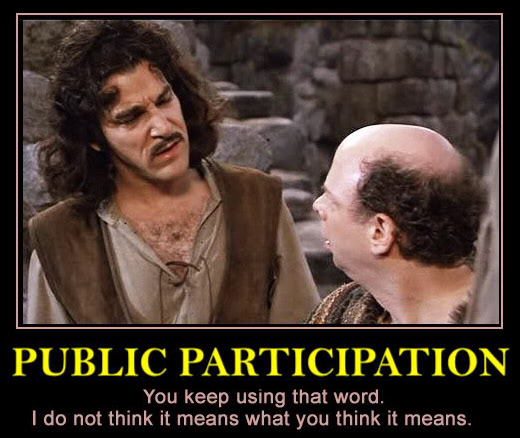
Inconceivable what you can learn from a good film 😀 (The Princess Bride)
Of course it is not that simple …… well actually maybe it is. You would not build a house without putting in proper foundations first. So if we are building for the future in an integrated manner we must put the work into the foundations of proper participation processes – that means working together to see what’s possible and realistic (that literally means in the same room working through stuff).

“Ah hold on, we don’t have time for that” I hear you say (We do hear that a lot).
2) Participation is not easy
Invariably time spent ‘in the courts’ and dealing with ‘opposition’ is longer than the time required to have a meaningful engagement process. The ‘us’ versus ‘them’ way of working will nearly always lead to mistrust and conflict, where authorities have to ‘deal with’ complaints, concerns and objections. Changing the mindset to one of “a problem shared is a problem solved” will open us up to the idea that within our collective knowledge we have enough processing power (individuals and their brains, their education, life and professional experiences, their values & goals) and a diversity of skills to get better results than we have been getting up to now.
The more people involved, the more ideas and skills.
BUT, and it’s a big but, doing this in an efficient and robust manner is not easy. There is no doubt that there is a severe lack of people with actual training in this very specific area – facilitating engagement processes. So employing skilled personnel or re-training existing staff with facilitation skills would be a very helpful development in getting those foundations on a more solid base.
Being good at facilitating takes work.
One of the added benefits of that solid base arises when things aren’t going as well as planned: if people have built good solid working relationships, making adjustments are always easier than starting a brand new project. This flexibility is very important when dealing with issues like climate change adaptation where uncertain outcomes are all too real.
3) Participation is neither Up nor Down
We often hear how bottom-up approaches (for example, a community-led project) on the one hand, or alternatively top-down schemes (for example, something led by local or national government) are the best way to approach an issue. Each has its pros and cons. The latest thinking though (in international best practice) is to combine these two, taking the best of both. In this scenario, things like decision-making experience, politics, financing, scale, legal know-how of the ‘top-down’, and the local knowledge, community values, local stewardship, diversity of voices of the ‘bottom-up’ give a more robust framework for better decision-making.
So in summary, let’s acknowledge what we have been doing is not working, and give this new approach a chance by taking the time to do it right.


Leave a Reply